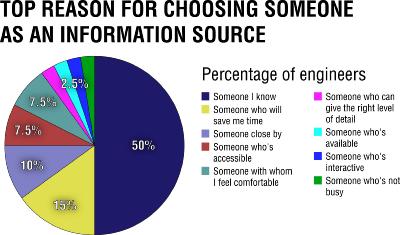
Even with the Internet at their fingertips, people who really need information are more likely to seek it from other people 鈥� especially people they know.
That is what 天美影院researchers discovered when they tracked, in minute detail, how 31 aerospace engineers obtained information vital to their work. The engineers usually chose human sources over written ones and were three times more likely to choose familiar people over experts they didn鈥檛 know.
The study by 天美影院Information School professor Raya Fidel and assistant professor Maurice Green will be published in the journal Information Processing and Management.
鈥淭he human side of information-seeking is so important,鈥� Fidel said. 鈥淭his shows that companies would benefit from encouraging richer social connections.鈥�
That could mean offering free cafeteria lunches once a week, or installing small kitchens where employees can 鈥渂ump into鈥� colleagues. Support meetings for people who do similar jobs, known as a 鈥渃ommunity of practice,鈥� also can expand connections, the researchers said.
鈥淏ut richer social connections do not result from management dictates 鈥� that doesn鈥檛 work,鈥� Green said. 鈥淧rovide a variety of incentives to the rank and file in order to encourage and support them as they make those connections.鈥�
The researchers analyzed more than 600 single-spaced pages of their transcribed interviews to understand the engineers鈥� thinking and performance in doing recent work tasks:
- Ninety-seven percent of the engineers consulted another person at least once, while 77 percent searched the Internet and intranet sites at least once.
- Among 117 situations in which a person was the source consulted, it most often was a co-worker (31 percent of cases), followed by an outside expert (29 percent).
- The most common reason for selecting a person as a source 鈥� by a factor of more than 3 to 1 鈥� was that the engineer knew the person.
Fidel, who also serves as co-director of the UW鈥檚 new Center for Human-Information Interaction, said the study validates the use of structured but open-ended interviews to dissect complex information-seeking processes. Larger-scale studies using the technique will lead, she said, to the design and implementation of information systems that can boost the productivity and satisfaction of workers in many fields.