If two renegade violins started quietly playing 鈥淥de to Joy鈥� during Beethoven鈥檚 鈥淔ifth Symphony,鈥� some audience members might sense a problem. If the errant violins increased in volume and recruited the woodwind and percussion sections, the result would just be noise. Researchers think something similar is happening when nerve cells in the brain of a Parkinson鈥檚 disease patient begin to exhibit abnormal firing patterns.
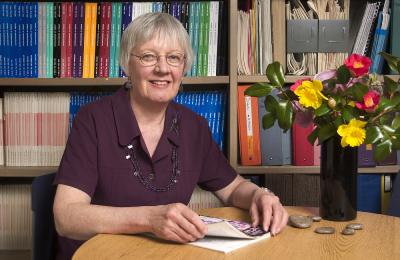
鈥淭here is a symphony of activity going on in the brain all the time,鈥� says Dr. Marjorie Anderson, professor and vice chair of rehabilitation medicine and professor of physiology and biophysics. 鈥淚n Parkinson鈥檚 patients, the normal activity of nerve cells is interrupted.鈥�
The nerve cells are actually responding to a deficit in the neurotransmitter dopamine. The results are the debilitating symptoms of Parkinson鈥檚, including chronic muscle tremors, rigidity, poor balance, and difficulties walking and coordinating movements. At least 1 million people have Parkinson鈥檚 disease, including Pope John Paul II and actor Michael J. Fox. At least half of these people may be undiagnosed, because the symptoms usually appear after a patient turns 50.
鈥淭here鈥檚 a lot of evidence to suggest that some people are susceptible to environmental factors,鈥� says Anderson. 鈥淎nd that, in conjunction with genetic predisposition to toxins, may trigger the onset of Parkinson鈥檚 symptoms.鈥�
Anderson鈥檚 career has focused on the globus pallidus, a part of the brain affected in Parkinson鈥檚 disease. To decrease the severity of Parkinson鈥檚 symptoms, patients may undergo a pallidotomy鈥攚here a lesion is actually burned into a patient鈥檚 brain. More recently, researchers have tried to implant stimulating electrodes in this part of the brain to alleviate Parkinson鈥檚 symptoms.
鈥淚t鈥檚 a bit of a paradox,鈥� explains Anderson. 鈥淚f you make a lesion in that part of the brain, it improves the patient鈥檚 symptoms, and if you stimulate through electrodes in that part of the brain, it also improves the symptoms. We are trying to understand why.鈥�
Anderson and her colleagues think the interruption of the abnormal pattern, rather than the over- or under-stimulation of the nerve cells, may be helping relieve the symptoms.
鈥淎bnormal patterns of nerve cell discharge may lead to the symptoms, so what we鈥檇 like figure out is how to overcome the abnormal patterns,鈥� says Anderson. 鈥淢y lab is trying to determine the mechanisms by which continuous deep-brain stimulation might act.鈥�
Anderson presents the Distinguished Scientist Science in Medicine Lecture, 鈥淟istening to the Brain: What Can It Tell Us About Movement Disorders?鈥� at noon, Thursday, May 22, in Hogness Auditorium at the Health Sciences Center.
Anderson received her Ph.D. in physiology and biophysics from the 天美影院in 1969. She was a postdoctoral fellow at the Rockefeller University in New York City from 1969 to 1971. She joined the 天美影院faculty as an assistant professor in rehabilitation medicine and an affiliate at the Primate Research Center in 1971. She joined the faculty in physiology and biophysics in 1973.
Among numerous honors, she has been a fellow of the American Association for the Advancement of Science since 1994. Anderson has served on the Advisory Board of the National Center for Medical Rehabilitation Research since 1999. She also is the director of the Western Medical Rehabilitation Research Network, funded by the National Institutes of Health to enhance rehabilitation research in the 15-state western region.