Sixteen-year-old Jolene Monk of Shoreline hopes to become an engineer 鈥� just like her mother.
That鈥檚 what brought her and 28 other high school students 鈥� half of them girls 鈥� from throughout Western Washington to the 天美影院campus last week for Materials Science Camp.
The camp is a six-day, hands-on experience for students who have shown an interest in math and the sciences. The young students鈥� career goals in science varied somewhat 鈥� one wants to be an astronaut, another aims for medical research and others weren鈥檛 sure yet. But they worked together all week through a shared love of science, and of having something cool to do in the summer.
The camp is sponsored by the ASM Materials Education Foundation, which is the outreach arm of ASM International, the Materials Information Society, which is a worldwide society and network of materials scientists and engineers. The campus host is the UW鈥檚 Materials Science and Engineering Department.
鈥淢aterials Science deals with the application of science,鈥� said Tom Stoebe, professor emeritus of materials science, who oversaw the week of research and scientific exploration. 鈥淚t鈥檚 about 50 percent applied chemistry and 50 percent applied physics.
鈥淭he idea is to demonstrate to kids that science is interesting, and that it relates to stuff they do every day. In high school they take physics and chemistry, but they seem esoteric, but you and I deal with materials science all the time.鈥�
After welcomes Monday morning from Stoebe, Materials Science Department Chairman Raj Bordia and other counselors and camp assistants, the students dove right in. Central to their week was study with Karen Hinkley, who during the school year teaches science at the Forest Ridge School of the Sacred Heart in Bellevue. Hinkley is an animated and expressive teacher who clearly loves imparting the joys of science. She and other teachers introduced the students to the properties and relative strengths of metals, ceramics, polymers and composites in successive sessions.
In between lab work and hands-on demonstrations and experiments, the students also got to tour Boeing鈥檚 Everett facility and heard information from academic counselor Kathy Elkins, who advised them how they might best prepare to study science at the UW.
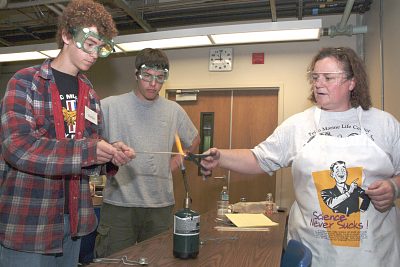
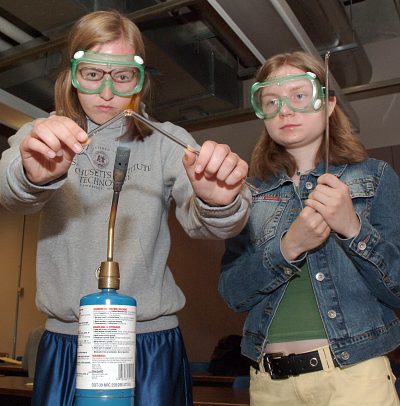
Wednesday morning found the students in a downstairs lab in Mueller Hall, watching as Hinkley lectured and demonstrated, then trying experiments for themselves. Hinkley had them heating and blowing intricately fine bubbles of glass (鈥渢he special ceramic鈥�) over a thin blue flame and learning about its strengths and weaknesses. For instance, Hinkley demonstrated with a beaker, 鈥渃racks will always propagate all the way through the material 鈥� so if you鈥檙e thinking of buying something with a crack in it, well, don鈥檛 buy it. It will get worse.鈥�
Jolene Monk, the Shoreline student, likened this to a ding in a windshield that will inevitably grow into a small crack, then a bigger one. Of the camp, she said, 鈥淚鈥檓 definitely more interested in biomedical sciences, but I wanted to see what materials science is like. We don鈥檛 have it in school.鈥� Overall, the science is similar to the essence of her mother鈥檚 job, she said. 鈥淢y mom is an engineer with Goodrich, and she has a Wall of Shame of things that have broken. She has to figure out why they broke.鈥�
Later, the students divided into groups to pursue different scientific experiments and projects that were at once real science and fun. Among these was one titled 鈥淐ombustion Characteristics of Bread Subject to Toaster Temperatures,鈥� and featured students (overseen by a teacher) toasting bread to 鈥� and far beyond 鈥� the point of combustion. The results, up to and including flaming toast, were duly marked down and studied.
At week鈥檚 end, the students regrouped to present reports on their various experiments and to share awards, final comments and a barbecue with their teachers and parents.
Hinkley said such a week of study can open students鈥� eyes to areas of science they may not have known or considered before. Materials science, she said, goes into the manufacture of many items in everyday life, recreation and medical science 鈥� from snowboards, skis and tennis rackets with great tensile strength to semiconductors, biomaterials and many aspects of nanotechnology.
This summer鈥檚 was the fifth annual Materials Science Camp, said Stoebe, who also is chairman of the ASM Foundation that helps provide the event each year. He said there has been follow-up done on previous camp participants. 鈥淪eventy-four percent go into science and engineering,鈥� he said.